
The Big Playground: 20 Lessons from an Investor Starting at -$25,000
By Carl Joshua Ncube
Starting an investment journey when you are currently sitting at negative $25,000 is an extreme sport. It requires the humor of a comedian and the precision of a chef. When you are in the red, every word used on the “Big Playground”—the Stock Exchange—matters more because you are playing for your comeback. To help you navigate the noise, I have expanded our list to twenty essential terms, explained simply enough for a five-year-old to understand, but serious enough for an adult to use.
The Stock
Imagine a giant chocolate cake. To grow the bakery, the owner cuts the cake into thousands of tiny crumbs. Each crumb is a stock. When you buy one, you own a tiny piece of the bakery. If the bakery does well, your crumb becomes worth more than you paid for it.
The Stock Exchange
This is the designated playground where everyone meets to trade their crumbs. It is a giant, organized market that ensures when you give someone your marbles, you actually get the piece of cake you were promised.
The Share Price
This is the price tag on a single crumb of cake. This number changes constantly based on how many kids on the playground want that cake versus how many kids are trying to get rid of theirs.
A Bull Market
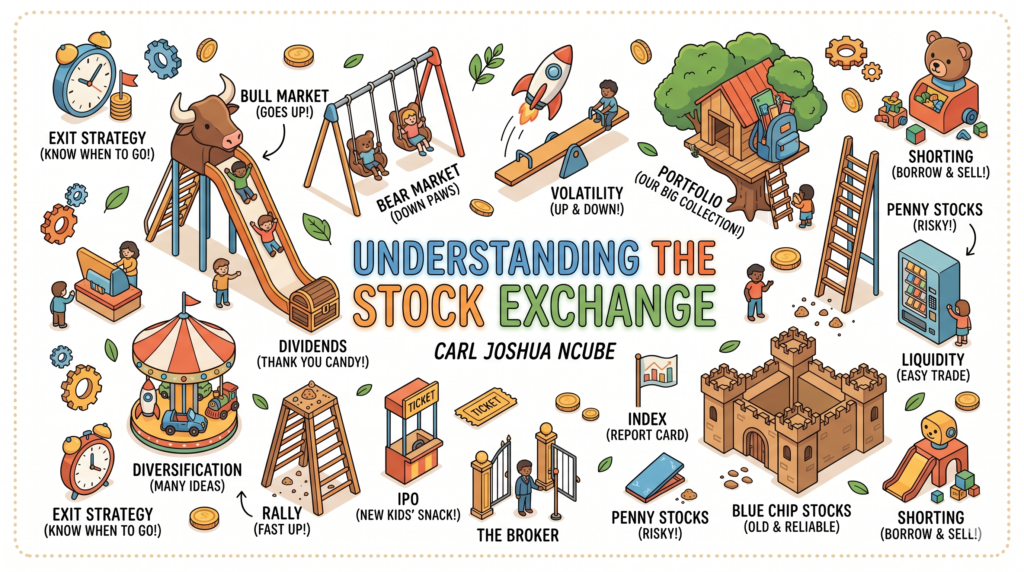
Think of a powerful bull tossing a ball up into the air with its horns. A Bull Market is a happy time when everyone believes the baker is doing a great job, and the price of every crumb keeps going higher and higher.
A Bear Market
A bear swipes its paws downward when it attacks. In a Bear Market, the playground gets quiet and a bit sad. Prices fall because people are worried there won’t be enough frosting to go around, and they start selling their crumbs quickly.
Dividends
Sometimes, the baker has a very good day and makes extra money. Instead of keeping it all, they give a little bit of sugar or a small coin to everyone who owns a crumb. These “thank you” payments for being a part-owner are called dividends.
Portfolio
A portfolio is your investment backpack. Inside, you don’t just keep one type of crumb; you might have crumbs from a tech bakery, a shoe factory, and a toy shop. It is the total collection of everything you own.
Diversification
This is the golden rule: never put all your cookies in one jar. If the jar breaks, you lose everything. Diversification means spreading your marbles across different jars so that if one breaks, you still have plenty of treats left in the others.
Volatility
Imagine a seesaw that moves up and down very fast. That is volatility. It describes how much and how quickly a price jumps around. When things are very volatile, the playground can feel a bit like a rollercoaster.
The Broker
You aren’t allowed to walk into the big bakery alone; you need a professional helper. The broker is the person who takes your order and your marbles, goes into the market, and makes the trade for you.
Shorting
This is a tricky move. Imagine you borrow a toy from a friend because you think that toy is about to become “uncool” and cheap. You sell it immediately for ten marbles. A week later, the toy is only worth five marbles. You buy it back for five, give the toy back to your friend, and keep the extra five marbles for yourself. You made money because the price went down.
Exit Strategy
Before you even step onto the playground, you need a plan for when to leave. An exit strategy is knowing exactly when you will sell your crumb—either because you made enough marbles to buy a bike, or because the bakery is starting to smell like burnt toast and you want to save what you have left.
Market Capitalization
This is just a fancy way of measuring how big the whole cake is. You find it by taking the price of one crumb and multiplying it by all the crumbs in existence. It tells you if you are looking at a tiny neighborhood cupcake or a massive global wedding cake.
IPO
The Initial Public Offering is like the very first day a new kid brings a brand-new type of snack to the playground. It is the first time a company allows the public to buy its crumbs, turning from a private family recipe into a snack everyone can own.
Blue Chip Stocks
Think of the oldest, most famous, and most reliable toy companies in the world—the ones your grandparents played with. Blue Chip stocks are big, solid companies that have been around a long time and aren’t likely to disappear overnight.
Liquidity
This describes how easy it is to turn your crumbs back into marbles. If everyone wants your cake, it has high liquidity because you can sell it instantly. If you own a weird, broccoli-flavored snack that nobody wants, it has low liquidity because you’re stuck with it.
Index
An index is like a report card for a whole group of companies. Instead of looking at one bakery, you look at a list of the top ten bakeries to see if the entire town is doing well or if the oven is broken for everyone.
Yield
Yield is a way to measure the “thank you” candy (dividends) you get compared to the price you paid for the crumb. It tells you exactly how much extra treat you are getting for every marble you spent.
Rally
A rally is a sudden burst of energy on the playground. It’s when everyone starts running toward a certain cake at the same time, causing the price to shoot up quickly after it has been low for a while.
Penny Stocks
These are the crumbs from very tiny, unknown bakeries that cost almost nothing—just a few marbles. They are very risky because the bakery might become famous tomorrow, or it might close down before lunchtime. For someone starting at -$25,000, these are tempting but very dangerous.
